.png)
TRT vs Natural Testosterone Boosters: What Actually Works?

If you've been feeling more tired than usual, noticing a lower sex drive, or struggling to maintain muscle, you may be wondering whether low testosterone is to blame. One of the most common questions I hear from men in Eugene and across Oregon is whether it's better to try a natural testosterone booster or testosterone replacement therapy (TRT).
I understand why it feels confusing. Supplements promise to boost testosterone naturally, while TRT is often seen as the more effective option.
Here's what I want you to know: they aren't competing treatments. They're designed for different situations. Some men improve with healthier habits, while others have medically confirmed low testosterone and may benefit from TRT.
The first step isn't choosing a treatment. It's understanding why your testosterone levels are low in the first place.
TRT vs Natural Testosterone Boosters

Natural testosterone boosters and TRT both aim to improve hormone health, but they're designed for different situations.
Feature | Natural Testosterone Boosters | Testosterone Replacement Therapy (TRT) |
Purpose | Support natural testosterone production | Replace testosterone directly |
Best For | Men with normal hormone levels or lifestyle-related decline | Men with confirmed low testosterone and symptoms |
Contains Testosterone | No | Yes |
Evidence | Lifestyle changes have the strongest evidence; supplements have mixed results | Supported by clinical guidelines |
Expected Results | Usually modest and gradual | Often more noticeable in appropriate candidates |
Medical Supervision | Not usually required | Required before and during treatment |
Blood Tests | Not typically needed | Required for diagnosis and follow-up |
Benefits | Supports hormone health and overall health | May improve energy, mood, libido, muscle mass, and sexual function |
Risks | Product quality varies | Requires ongoing monitoring |
Availability | Over the counter | Prescription only |
Neither option is automatically better. If your testosterone levels are normal, healthy lifestyle changes may be all you need. If blood tests confirm testosterone deficiency, TRT may be the more effective treatment because it replaces the hormone your body isn't producing.
Why Comparing TRT and Testosterone Boosters Can Be Misleading
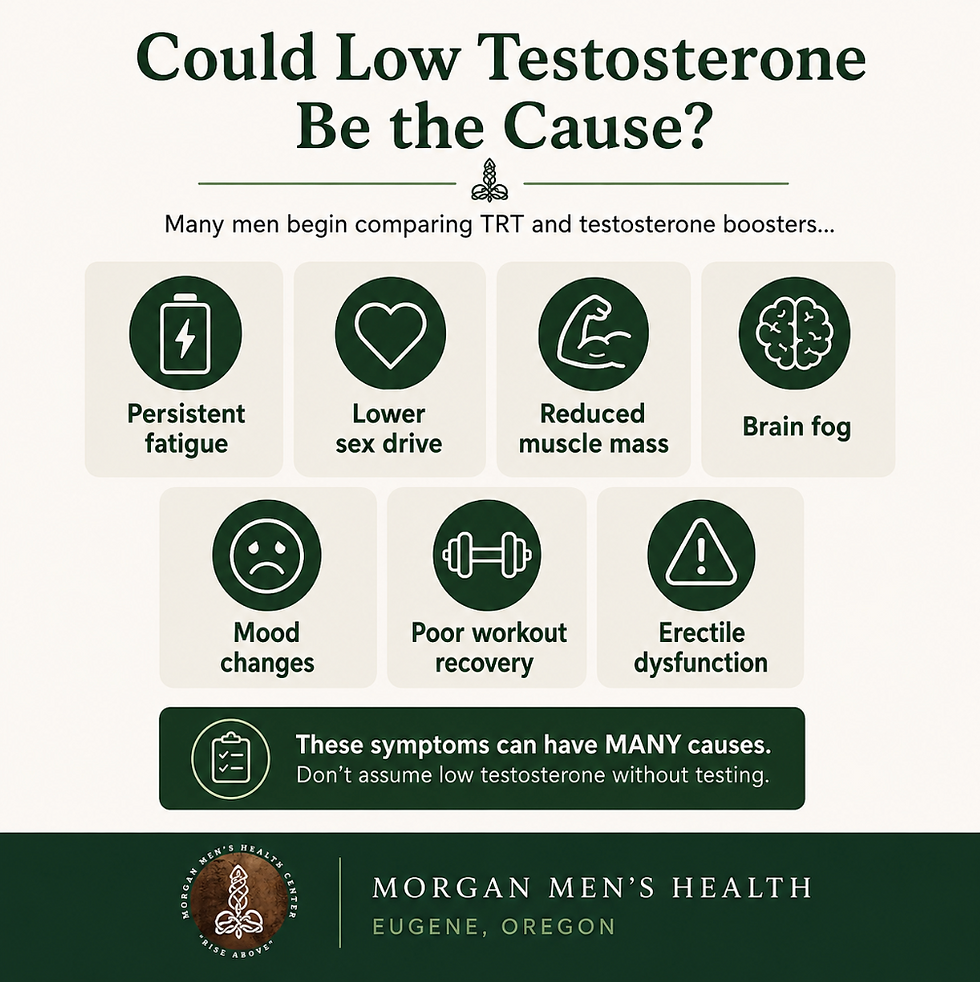
Many patients who come to Morgan Men's Health are convinced they have low testosterone. Because they're feeling tired, their workouts aren't producing the same results, or their sex drive has declined.
Sometimes they're right. Sometimes they're not.
Low testosterone can cause persistent fatigue, reduced muscle mass, mood changes, brain fog, and erectile dysfunction. But those same symptoms can also be caused by poor sleep, chronic stress, weight gain, thyroid disease, depression, or certain medications.
That's why I don't recommend diagnosing yourself based on symptoms alone.
Before we talk about treatment, I want to understand what's causing them. That means reviewing your medical history, lifestyle, medications, and blood tests before deciding whether TRT is appropriate.
If you've ever felt like something just feels off, it's worth finding the cause instead of assuming testosterone is the problem.
What Natural Testosterone Boosters Can—and Can't—Do
Many patients tell me they'd rather try natural testosterone boosters before considering TRT. I understand that. If there's a safe way to boost testosterone naturally, it makes sense to start there.
The important thing to remember is that natural testosterone boosters and testosterone replacement therapy serve different purposes. Boosters aim to support your body's natural testosterone production, while TRT replaces testosterone when your body isn't producing enough on its own.
Healthy Habits Come First

If your testosterone levels are normal or only mildly affected by lifestyle factors, healthy habits often make the biggest difference.
Research consistently supports:
Resistance or strength training
Maintaining a healthy weight
Sleeping seven to nine hours each night
Eating a balanced diet with lean protein and healthy fats
Managing stress
Limiting alcohol intake
I've seen many men feel more energetic simply by improving their sleep, exercising consistently, and maintaining a healthier weight. Even if TRT eventually becomes appropriate, these habits remain an important part of treatment.
Do Testosterone Supplements Work?
Patients ask me this all the time.
The short answer is sometimes—but not as much as many advertisements suggest.
Most testosterone boosters are over-the-counter supplements that don't contain testosterone. Instead, they use ingredients like ashwagandha, fenugreek, vitamin D, zinc, and D-aspartic acid to support the body's natural testosterone production.
The evidence is mixed. Some studies suggest ashwagandha may modestly increase testosterone after about 90 days, but research on ingredients like fenugreek, zinc, maca, and D-aspartic acid has been inconsistent. A systematic review also found that most marketed testosterone boosters don't reliably increase testosterone levels.
That doesn't mean they're useless. It means the benefits are usually modest, product quality can vary, and they're not a substitute for treating testosterone deficiency.
When Natural Approaches Make Sense
Natural approaches are often the best place to start if your testosterone levels are normal and your symptoms are related to lifestyle.
But if you're exercising regularly, eating well, sleeping enough, and maintaining a healthy weight without feeling better, another supplement probably isn't the answer. At that point, it's worth finding out whether low testosterone—or another medical condition—is causing your symptoms.
If you've already made healthy lifestyle changes and still don't feel like yourself, a hormone evaluation can help identify the cause before you spend more money on supplements.
How Testosterone Replacement Therapy Works

One misconception I hear all the time is that TRT is simply a stronger testosterone booster.
It isn't.
Testosterone replacement therapy uses prescription medication to replace testosterone in men whose bodies aren't producing enough on their own. Unlike natural testosterone boosters, TRT replaces the hormone rather than encouraging your body to produce more.
Because TRT directly changes hormone levels, it should only begin after symptoms, repeat blood tests, and a medical evaluation confirm testosterone deficiency.
If you'd like a deeper explanation, my Testosterone Truths masterclass explores how TRT works, common myths, and what you can realistically expect.
Who Is TRT Designed For?
TRT isn't recommended simply because you're getting older or feeling tired.
I recommend testosterone replacement therapy when you have:
Symptoms of low testosterone
Consistently low blood testosterone levels
A medical evaluation confirming testosterone deficiency
I've treated younger men who needed TRT and older men whose testosterone levels were completely normal. The decision isn't based on age—it's based on your symptoms, blood tests, medical history, and overall health.
Why Medical Supervision Matters
TRT doesn't end with a prescription. Because it changes your hormone levels, regular follow-up is important to monitor your symptoms, repeat blood tests, and adjust treatment if needed. We'll also monitor blood values, including hemoglobin and hematocrit, and discuss fertility since TRT can reduce sperm production.
My goal isn't simply to prescribe testosterone. It's to recommend the treatment that's right for you while monitoring your health over time.
When Natural Approaches May Be Enough
Not every man with low testosterone symptoms needs TRT.
If your testosterone levels are normal, or your symptoms are related to poor sleep, excess weight, chronic stress, or an unhealthy diet, lifestyle changes are often the best place to start.
If you're looking to boost testosterone naturally, focus on habits with the strongest evidence:
Resistance or strength training
Maintaining a healthy weight
Eating a balanced diet with lean protein and healthy fats
Getting seven to nine hours of sleep each night
Managing stress
Limiting alcohol intake
Correcting a vitamin D deficiency may also help when blood tests confirm one. I encourage patients to think of testosterone supplements as supportive tools, not miracle solutions.
When It May Be Time to Consider TRT
Sometimes, healthy habits aren't enough.
If you've improved your lifestyle but still have persistent fatigue, low libido, reduced muscle mass, brain fog, or mood changes, it's worth finding out whether low testosterone is the cause.
TRT becomes part of the conversation when your symptoms and blood tests point to the same diagnosis.
You may benefit from an evaluation if you have:
Persistent fatigue
Low libido
Erectile dysfunction
Reduced muscle mass or strength
Mood changes
Difficulty concentrating
Little improvement despite healthy lifestyle changes
Before recommending testosterone replacement therapy, I confirm consistently low morning testosterone levels with repeat blood tests. Depending on the findings, additional hormone testing may help identify the cause.
The goal isn't simply to restore testosterone. It's to understand what's causing your symptoms and recommend the treatment that's most likely to help.
How I Decide Between Lifestyle Changes and TRT
One of the first questions patients ask me is, "How do you know if I actually need TRT?"
The answer comes from looking at the whole picture—not just one symptom or one blood test.
During your evaluation at Morgan Men's Health, we'll review your symptoms, medical history, medications, lifestyle, fertility goals, and blood test results. Sometimes we find another condition that's contributing to your symptoms. Other times, the findings confirm testosterone deficiency.
If TRT is appropriate, we'll talk through your options together. If it isn't, we'll focus on the treatment that's most likely to help.
You don't have to keep guessing what's causing your symptoms. A comprehensive men's health evaluation can help determine whether lifestyle changes, additional testing, or testosterone replacement therapy is the right next step.
Frequently Asked Questions
Does TRT work better than natural testosterone boosters? If you have medically confirmed low testosterone, TRT is generally much more effective because it replaces the hormone your body isn't producing. If your testosterone levels are normal, healthy lifestyle changes are usually more beneficial than over-the-counter testosterone boosters.
Do testosterone boosters actually work? Some testosterone boosting supplements may have modest benefits, but most don't reliably increase testosterone levels. Research consistently shows that lifestyle measures like resistance training, healthy weight management, and quality sleep have stronger evidence than most supplements.
Can I increase testosterone naturally? Often, yes. Many men can boost testosterone naturally by exercising regularly, maintaining a healthy weight, eating a balanced diet, sleeping well, and limiting alcohol. These habits also support your overall health, whether or not you eventually need testosterone therapy.
Are testosterone boosters safe? Not always. Most over-the-counter supplements aren't regulated like prescription medications, so ingredient quality and dosage can vary. Some may also interact with prescription drugs or other medications. It's a good idea to talk with a healthcare professional before starting any supplement.
Does TRT affect fertility? Yes. Testosterone replacement therapy can reduce sperm production and affect fertility. If having children is important to you, we'll discuss that before starting treatment and review other options if appropriate.
Are natural testosterone boosters safer because they're natural? Natural doesn't always mean safer—or more effective. Many products contain natural ingredients, but that doesn't guarantee they'll increase testosterone or improve symptoms. Choosing treatment based on advertising instead of a medical evaluation can delay finding the real cause of the problem.
What's Your Next Step?
If you're comparing TRT vs natural testosterone boosters, the first step isn't choosing a treatment. It's finding out what's causing your symptoms.
Some men improve with healthy lifestyle changes. Others have medically confirmed low testosterone and may benefit from testosterone replacement therapy. The right approach depends on your symptoms, blood tests, and overall health.
You don't have to figure that out on your own.
At Morgan Men's Health in Eugene, OR, I'll help you understand what's causing your symptoms and whether lifestyle changes, additional testing, or TRT is the right next step. If you've been dealing with persistent fatigue, lower libido, reduced muscle mass, or other symptoms of low testosterone, a hormone evaluation can provide the answers you've been looking for.

Comments